I used to think I was a good communicator. Then I watched a recording of myself in a meeting. I said “sort of” eleven times in four minutes. Eleven. I counted afterward, sitting in my car in the parking garage, feeling something between embarrassment and fascination. That was the day I started looking for the best books for better conversations, not because I wanted to become a smooth talker, but because I wanted to stop being a person who said things they didn’t mean.
Why Do Our Words Come Out Different Than We Mean?
There’s a gap between what you feel and what you say. Everyone has it. Mine is wider than most, I think.
I remember telling my colleague, “That’s an interesting approach.” What I meant was: this will not work and I’m worried about the deadline. She heard: maybe, let’s see. We lost a week.
Why does this happen? Because we’re managing two things at once. We’re managing the message, and we’re managing how the other person feels about us. When those two goals pull in different directions, the message gets smudged.
Some of us lean toward being too soft. Some lean too sharp. Either way, the real thought gets buried under layers of cushioning or armor.

The moment I realized I couldn’t keep doing this
My brother asked me to lend him money. I said yes. I did not want to say yes. I spent three months resentful, and he had no idea. The problem wasn’t the money. The problem was that I had no way to say “I can’t do this right now” without feeling like a terrible person.
That’s when I found a book that changed things for me.
BOOKS FOR BETTER CONVERSATIONS: What Actually Helped
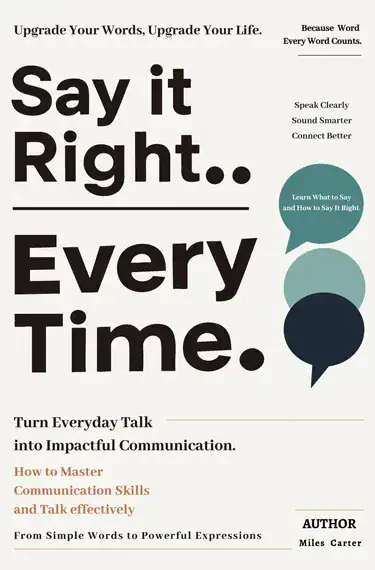
Say It Right Every Time by Miles Carter
I found this one by accident, browsing a bookstore I’d never been to before. The subtitle got me: “Practical tools for the moments that matter, say what you mean, calmly.”
What I liked most was the structure. Carter takes a real situation, a job interview, a request to a friend, a conflict with a coworker, and shows you two versions of the same message. The basic version. And the mature version. Side by side. Then he explains why one lands and the other doesn’t.
I remember one comparison about asking for a raise. The first version sounded like an apology. The second sounded like a statement of fact. Same information. Completely different weight.
The chapters include case studies, which I appreciated because I learn better from stories than from rules. Carter doesn’t tell you to memorize scripts. He shows you how specific people handled specific moments, and you start to see the pattern.
It covers saying no, making requests, and handling conflict. Which, honestly, is most of adult life.
What I didn’t expect
The book talks about emotional connection in daily conversation. Not in a sappy way. More like: here’s why this sentence pushes people away, and here’s what to say instead. I started noticing my own patterns within a week. The “sort of” problem. The way I’d soften every opinion until it disappeared.
How Do You Practice These Skills Without Feeling Fake?
This is the question I kept asking myself. Because reading about better communication and actually doing it are two different things.
Here’s what worked for me:
Start with one situation. I picked saying no. Just that. For two weeks, every time someone asked me for something I didn’t want to give, I paused. I said, “Let me check and get back to you.” That pause gave me time to decide whether my yes was real.
Record yourself. Just once. It’s uncomfortable. Do it anyway. You’ll hear things you didn’t know you were doing.
Use a bridge phrase. When I need to disagree but don’t want to sound harsh, I say, “Help me understand your thinking on that.” It’s not a trick. It’s genuine. But it buys me a second to organize my actual response.
The Time I Actually Used It
My friend asked me to help her move. On a Saturday. The same Saturday I’d been protecting for weeks because I was exhausted.
Old me would have said yes and hated every minute. New me said: “I can’t do this Saturday. I’m running on empty. But I can help you pack on Thursday evening if that’s useful.”
She said yes. She wasn’t upset. I couldn’t believe it.
Communication Isn’t Talent, It’s Practice
I used to believe some people were just naturally good with words. Maybe that’s true for a few. But for most of us, it’s a skill you build, badly at first, then less badly.
Why do people misunderstand what you really mean? Often because you haven’t decided what you actually want to say before you open your mouth. That’s not a character flaw. It’s just something nobody taught us.
Why is saying no so difficult? Because we’ve been taught that no is a rejection of the person, when it’s really just a boundary around the thing. Carter’s book helped me see that distinction clearly.
How can you express your feelings without creating conflict? You can’t always. Sometimes conflict happens. But you can express them without cruelty, and that changes the aftermath.
How can you become someone people trust and respect? By being consistent. By meaning what you say. By not agreeing to things you’ll resent later. Trust isn’t built through charm. It’s built through reliability, and reliability starts with honesty about what you can and cannot do.
A few other books worth mentioning
I won’t pretend I’ve read everything. But two others stayed with me.
One is about negotiation, which sounds corporate but is really about everyday conversations where both people want different things. It taught me that “no” is often the beginning of a real discussion, not the end.
Another is a collection of essays about listening. Not techniques. Just reflections on what happens when you actually shut up and pay attention. I read it slowly, one essay at a time, usually in the morning with coffee.
One Last Thing
I still say “sort of” sometimes. I caught myself yesterday, in fact. But I notice it now, and noticing is where everything starts.
The best books for better conversations don’t give you a new personality. They give you a mirror and a few tools. What you do with them is still up to you, on a Tuesday afternoon, in a meeting you didn’t want to attend, when someone asks you a question and you have exactly one second to decide who you want to be.
I’m still deciding. Most days, I get a little closer.
References:
Carter, M. Say It Right Every Time.
Stone, D., Patton, B., & Heen, S. Difficult Conversations: How to Discuss What Matters Most.
Ury, W. The Power of a Positive No.