Somewhere between a meeting where I said the exact wrong thing and a dinner where I stayed quiet for twenty minutes because I couldn’t find the words, I bought four books on speaking well. I finished two. I actually used one. That’s the honest math of self-help, right?
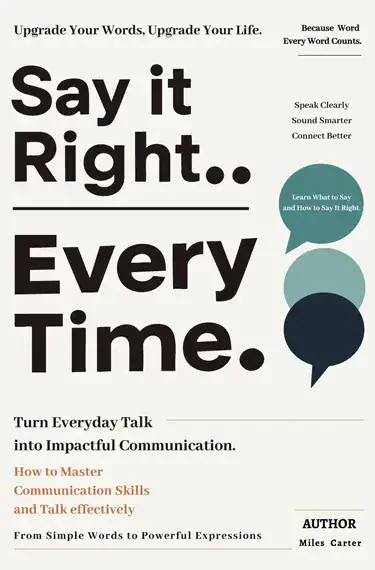
This is about the one that stuck. Say It Right Every Time by Miles Carter. If you’ve ever rehearsed a sentence in your head, said it out loud, and watched it land wrong, this is for you.
Why Do We Keep Saying the Wrong Thing?
You know what you mean. The words come out sideways anyway. You meant to be firm and sounded cold. You meant to be gentle and sounded unsure.
I used to think this was a personality problem. I’m bad at confrontation, so I avoid it. Then I read Carter’s book and saw the real issue sitting on the page. I was choosing Basic Expressions when I wanted Mature ones. That’s his whole framework. Every section puts two versions side by side.
Basic: “You didn’t think of me.”
Mature: “That made me feel left out.”
Same feeling. Completely different reception. Why did nobody teach me this at twenty-two?
The book’s core claim is simple and, honestly, a little annoying because it’s true. It’s not what you say. It’s how you say it. And the how is craft. Learnable. Boringly learnable.
How Do These Books Actually Help?
Most of them don’t. Let’s be honest about that first.
Some books hand you theory. Some hand you confidence slogans. Carter hands you scripts. That’s the difference I noticed within the first forty pages. He doesn’t tell you to “be more assertive.” He shows you what assertive sounds like in a specific sentence, then shows you the weaker version right beside it.
Basic: “I don’t want to.”
Mature: “I prefer that you didn’t.”
Is the second one stronger? It doesn’t feel stronger. It feels softer. But watch what happens when you say it out loud to a real person. The first invites an argument. The second closes the door politely. That gap between feeling and effect is what good books train you to see.
So when people ask me which speaking books are worth the money, my answer is simple. The ones with examples. If a book has no side-by-side sentences, it’s a mood, not a manual.
Say Thank You Instead of Sorry
This one changed my daily life more than anything else in the book.
Carter’s argument. “Sorry I’m late” puts you below the other person. “Thanks for waiting” puts you beside them. Same situation. Same acknowledgment. Entirely different posture.
I tried it for a week. With my partner. With a colleague who waits for me every Tuesday. My instinct kept reaching for “sorry” and I kept swapping it at the last second. It felt unnatural. Around day five it stopped feeling unnatural.
Why does such a small swap matter? Because sorry accumulates. Say it forty times a day and you start believing you’re a burden. Say thank you instead and you’re just a person who notices other people. That’s a different identity, built one sentence at a time.
The Strategic Pause
Here’s the technique I resisted longest. Carter calls it strategic pausing. Silence, used on purpose, before you respond.
My instinct in conflict is to fill every gap. Someone says something sharp, I answer within half a second. Usually with something I regret.
The idea is simple. When someone pushes, wait. Two seconds. Three. Let the silence do the work. It signals you’re not rattled, and it gives your emotion a moment to settle before it drives.
Does it feel awkward the first ten times? Extremely. Does it work? In my experience, yes. People often soften their own statement during that pause. They hear themselves. You didn’t have to correct them.
Carter pairs this with the Echo Technique. Repeat back what the other person seems to feel before you respond to what they said. “So you felt like I ignored your message.” Nine times out of ten, the temperature drops. Not because you agreed. Because they felt heard.
From Small Talk to Hard Conversations
What surprised me about this book is the range.
Part one covers everyday social skills. Part two handles relationships and emotional support. Part three is about staying calm when someone is rude, lying, or manipulating. Part four is the workplace. Interviews, salary talks, boundaries, credit-stealing coworkers, passive-aggressive emails.
That last part is the strongest. The scripts for asking for a raise are worth the price alone. Carter frames it as a gain, not a loss. “Here’s what I’ve delivered this year” instead of “I haven’t gotten a raise in two years.” Same facts. Different room temperature.
He calls this the Framing Effect. Present the same truth as a gain or a loss and watch the reaction change. “We retain 90%” lands differently than “we lose 10%,” even though the numbers are identical. I’ve used this in work updates since. It’s not manipulation, exactly. More like choosing which door to open.
The Let-Go Mindset
The final principle is the one I still struggle with. Carter calls it the Let-Go Mindset. Release the need to be agreed with, the need to fix everyone, the need to keep score.
Reading it, I felt called out. I keep score constantly. Who apologized last time. Who texted first. Who remembered the birthday. All that accounting runs in the background and drains something.
The book’s suggestion isn’t to stop caring. It’s to stop needing the other person to confirm you were right. You can say your piece clearly, calmly, and then let the outcome breathe. Some conversations resolve next week. Some never do. Your job is your half of the sentence.
Does that sound soft? I thought so too. Then I noticed how much energy I’d been spending on being right, and how little it ever bought me.

What the Book Doesn’t Do
It won’t make you charming. It won’t rewrite your personality. Carter says this himself, more or less. The goal isn’t to sound perfect. It’s to say what you mean without sounding too harsh, too passive, or unsure.
That’s a modest promise. It’s also the only promise I’ve seen a communication book actually keep.
If you’re building a shelf of books on speaking well, start here. Then practice one script a week. One. Not ten. The thank-you swap is a fine first week. The strategic pause is a good second.
One Last Thing
I still hear my own voice land wrong sometimes. A sentence comes out sharper than I meant, and I watch it hit. But now there’s a half-second gap between the regret and the next sentence. That gap is where the book lives. It’s small. It’s everything.
That’s what I wanted when I went looking for books on speaking well. Not a new personality. Just a little more room between feeling and speaking. Turns out that room is where most of the good conversations happen.
References
- Carter, Miles. Say It Right Every Time.
- Stone, Douglas, Bruce Patton, and Sheila Heen. Difficult Conversations: How to Discuss What Matters Most. Penguin Books.
- Patterson, Kerry, et al. Crucial Conversations: Tools for Talking When Stakes Are High. McGraw-Hill.