I still remember the meeting where I said the right words in the wrong order. My manager nodded slowly. My colleague looked at the table. I had meant to sound confident and collaborative. What came out sounded like a complaint wrapped in an apology. That night I went home and ordered three books to improve my speaking skills. Not because I wanted to become a public speaker. I just wanted to stop wincing at my own sentences.
If you have ever rehearsed a conversation in the shower and then watched it fall apart in real life, you know the feeling. The gap between what you mean and what people hear. That gap is where most of our daily frustration lives.
Quick Answer: Which book actually improves your speaking skills?
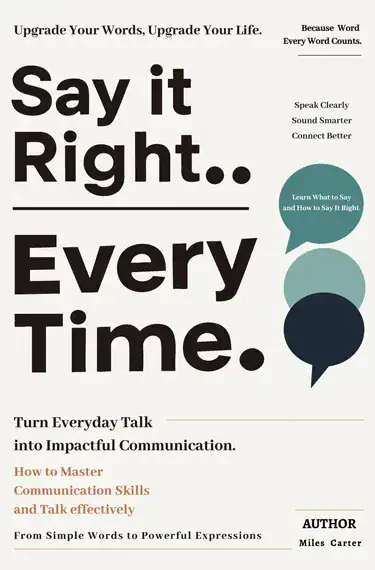
Say It Right Every Time by Miles Carter. It gives you real sentences side by side, so you can see the difference between what sounds nervous and what sounds clear.

Why Do So Many Communication Books Fail Us?
Most communication books explain theory. They tell you about listening styles, personality types, conflict cycles. You finish the book feeling informed. Then someone asks you a pointed question at work and your mind goes blank.
Here is what I have noticed after reading too many of these books. The ones that stick are not the ones with the best frameworks. They are the ones that give you actual sentences. Words you can borrow before you have your own.
I once spent a month reading a famous negotiation book. Great ideas. But when my neighbor confronted me about parking, I still mumbled something about maybe we can both try. The book had no script for that moment.
That is the real problem. We do not need more concepts. We need phrases we can reach for when our heart is beating fast.
Why Say It Right Every Time Stands Out
Let me tell you about one that surprised me. It is called Say It Right Every Time by Miles Carter. I picked it up because the subtitle promised practical tools for the moments that matter. That sounded less like a lecture and more like a toolbox.
The book does something simple but rare. It puts two versions of the same sentence side by side. One is what most of us say when we are nervous or annoyed. The other is what we wish we had said. You see the difference immediately. No theory required.
For example, instead of saying I don’t think that will work, the book suggests something like I see it differently. Can I walk you through my concern? Same meaning. Completely different reception.
I tried this in a phone call with a client last week. She wanted to move a deadline up by five days. My old instinct would have been to sigh and say that’s going to be really hard. Instead I said, I want to make that work. Let me tell you what’s realistic and we can figure out the rest together. She paused. Then she said, okay, what’s realistic?
That conversation took four minutes. The old version would have taken three days of resentment.
Why Is Saying No So Painfully Hard?
There is a chapter in Say It Right Every Time about saying no. I read it twice. Not because it was complicated. Because it was embarrassingly accurate.
The book points out that most of us treat no as a door slamming. So we either avoid it or wrap it in so many cushions that nobody hears it. Then we end up doing things we never agreed to, and we feel used.
The book offers a different frame. A no is just information. It tells the other person where your boundary is. Without that information, they are guessing. And people guess wrong.
I used to tell my sister maybe when she asked me to help with her weekend market stall. I meant no. She heard probably yes, just later. Then Saturday would come and she would be upset, and I would be confused. One sentence from this book changed that. Now I say, I can’t do Saturday. I can help you set up Friday night if that’s useful. Clear. Kind. Done.
How Do You Speak Clearly When Your Heart Is Racing?
The book has a small technique I have started using before any difficult conversation. It takes about twenty seconds. I call it the Three-Breath Reset.
Here is how it works. Before you speak, take three slow breaths. On the first breath, ask yourself, what do I actually want here? On the second, what does the other person need to hear? On the third, what is the simplest true sentence I can say?
That is it. No visualization. No power pose. Just three questions and a pause.
I used this before a job interview last month. The interviewer asked why I had left my previous role. My prepared answer was two minutes long and full of careful language. After the three breaths, I said, I outgrew the role. I wanted more responsibility than the structure allowed. He nodded and moved on. Short. True. Effective.
What Makes This Book Different?
Most books tell you to be assertive or listen actively. Those are good goals. They are terrible instructions. How do you be assertive? What does active listening actually sound like?
Say It Right Every Time gives you the words. Each chapter has case studies. Real scenarios. A conversation with a difficult coworker. Asking for a raise. Apologizing without groveling. Handling a friend who keeps crossing your boundaries.
You read the case study. You see the ineffective version. You see the effective version. You practice in your head. Then you try it in real life.
I have read books that made me feel smart. This one made me feel prepared. There is a difference.
Do These Skills Work Outside the Office?
I was skeptical about this part. Workplace communication books often feel stiff at home. You do not want to circle back with your partner about the dishes.
But the principles translate. The book talks about gentle firmness. That phrase stuck with me. It means you can hold a boundary without raising your voice or backing down.
My partner and I used to have the same argument every month about household chores. I would list everything I had done. He would list everything he had done. Nobody won. Nobody felt heard.
Last week I tried something from the book. Instead of listing, I said, I feel like I’m carrying more of the daily stuff lately. Can we look at the week together and rebalance? He did not get defensive. He actually opened his calendar. We spent ten minutes and fixed something we had been fighting about for a year.
Where Should You Start If You Only Have One Week?
If you are short on time, start with the chapter on requests. It is the one most people need first. Asking for what you want without sounding demanding is a skill almost nobody teaches.
Then read the chapter on conflict. Not because you fight a lot. Because you probably avoid conflict, and that avoidance has a cost.
Save the chapter on interviews for when you need it. It is excellent, but it is specific. The other chapters apply every single day.
FAQ
Is this book only for work situations?
No. The skills apply to family, friends, and everyday conversations. The examples are mostly work-related, but the principles translate everywhere.
How long does it take to see improvement?
You can use a phrase the same day you read it. Real change takes a few weeks of practice. Start with one chapter and one phrase.
What if I am naturally introverted?
This book is actually great for introverts. It gives you scripts so you do not have to improvise when you are already nervous.
Do I need to read the whole book?
No. Start with the chapter on requests. Then read the one on conflict. The rest can wait until you need it.
Is it worth reading if I already communicate well?
Yes. Even good communicators have moments where they blank. This book fills those gaps with words you can borrow.
A Closing Thought
I still have conversations that go sideways. Last Tuesday I said something clumsy to a friend and spent an hour replaying it. The difference now is that I know what I would say next time. That knowledge does not come from being a naturally gifted speaker. It comes from having a few good sentences ready.
If you are tired of walking away from conversations wishing you had said something else, pick up a book that gives you the words. Not the theory. The words. Then use them. Badly at first. Then better.
The gap between who you are and how you sound does not have to stay that wide.