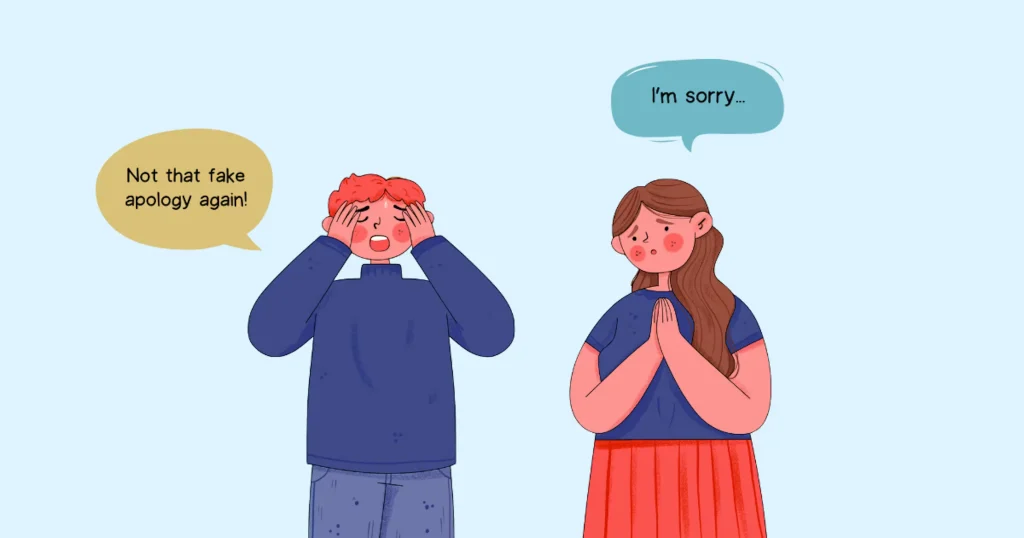
You say “sorry” when someone bumps into you. You apologize for asking a question in a meeting. You say “I’m so sorry” to a waiter who brings you the wrong dish. You did nothing wrong, but “sorry” still comes out.
I did this for years. I apologized to my dog for walking too slow. I said sorry to a vending machine when it ate my dollar. That was when I realized this was not politeness but a reflex. And it was eating my energy.
So I tried to fix myself the American way. I read books on confidence. I forced myself to stop. I put a rubber band on my wrist and snapped it against my wrist every time I apologized. None of it worked. I just felt guilty about apologizing, and then guilty again about failing to stop.
That is when I switched to a different method. Small stages. No shaming. Here is exactly what I did.
Stage 1: Just Notice Without Fixing
- Starting point: I said “sorry” about twenty times a day. I did not even hear myself anymore.
- Goal: Catch the behavior without judging it.
- What I did: For one week, I wore a rubber band on my wrist. Every time I apologized unnecessarily, I moved the rubber band from one wrist to the other. No scolding. No stopping. Just noticing.
- Mental shift: By day five, I was shocked. I apologized for sneezing, for taking up space, for asking a store clerk a question. Seeing the number changed something.
- Summary for this stage: You cannot change what you do not see. Just watch for one week. No fixing yet.
Stage 2: Delay the Automatic Response
- Starting point: I still apologized constantly, but now I noticed it.
- Goal: Insert a three-second pause between trigger and reaction.
- What I did: When I felt the word “sorry” rise in my throat, I counted to three in my head. Then I decided. Most times I still said it. That was fine. The pause itself was the win.
- Mental shift: I learned that the urge to apologize would peak and then pass. It felt like holding a wave. After a few days, about one out of ten times I stayed quiet instead.
- Summary for this stage: You are retraining a reflex. Pausing is progress.
Stage 3: Swap One Word At a Time
- Starting point: I was staying quiet maybe two times a day.
- Goal: Replace apology language with neutral or thankful language.
- What I did: Instead of “sorry I am late,” I tried “thank you for waiting.” Instead of “sorry for asking,” I said “I have a question.” I wrote these swaps on a sticky note on my computer.
- Mental shift: The first time I said “thank you for waiting” instead of apologizing, my heart pounded. Nothing bad happened. The other person just said “no problem.” That tiny success felt huge.
- Summary for this stage: Words shape how you see yourself. Change the words first. The feeling follows later.

Stage 4: Take One Low-Risk Stand
- Starting point: I could thank people instead of apologizing. But voicing a different opinion still terrified me.
- Goal: Express a small preference without defending it.
- What I did: I picked easy situations. A cashier asked paper or plastic. I said paper and stopped talking. A friend asked where to eat. I said “Italian” without adding “but anywhere is fine.” No explanations. No justifications.
- Mental shift: The world did not collapse. People did not get angry; most did not care at all. I realized I had been overestimating how much others noticed what I said.
- Summary for this stage: Start with choices that do not matter. Build the muscle in low-stakes moments.
What Changed After Four Stages
I still say sorry sometimes. That is human. But I no longer apologize for existing. I speak up in meetings about half the time now. More importantly, the hidden shame faded. I stopped believing that I was the problem in every room.
Today’s Practice For You
Do not try to stop apologizing yet. Just count how many times you say sorry today for something you did not do wrong. Write the number down. That is it. Stage one. Start there.
You did not learn this reflex overnight. You will not unlearn it in a week. But you can start noticing today. And noticing is how change begins.