Today, we invited “Anxiety” into the studio.
To be honest, I was a bit nervous when I sent the invitation. After all, in most people’s minds, it’s an uninvited nuisance — knocking on your door when you’re trying to relax, raising its voice when you need to focus.
The door opened, and “Anxiety” walked in. It wasn’t as repulsive as I had imagined. On the contrary, it looked like an overly alert safety officer, holding a thick notebook filled with densely packed notes of “things that could go wrong.”
I took a deep breath and began the interview.
Q: Why do you always show up when I need to be calm the most? Like at 3 a.m.?
A: Because that’s when you most “need” my reminder. My job is not to torture you. It’s to protect you. At 3 a.m., your brain is digging through old accounts — those unresolved hidden dangers. My method is not likable, but my intention is to keep you from getting hurt.

Q: But sometimes you go too far. You blow a small thing into a disaster.
A: (Flips through notebook) I admit it. I tend to overreact. Tens of thousands of years ago, the rustling of grass in the bushes could be a wild animal. Overreaction could save your life. But now, when your boss says, “Come to my office,” you react the same way you did to that rustling sound. I haven’t evolved fast enough.
Q: So what do we need to do to get you to settle down?
A: There’s no shutdown button. The harder you fight me, the more worked up I get. What you need to do is say to me: “Message received. Please go back to your seat.” I’m not your enemy. I’m your employee. What I need is an answer — not a fight.
Three takeaways after the interview:
1. Look at what anxiety is reminding you about
Anxiety is an indicator light, not the malfunction itself. Stop and ask: If anxiety were an honest messenger, what is it trying to say? It might be a task that hasn’t been broken down yet. It might be a conversation you haven’t prepared for. You don’t need to unplug the light bulb. You need to check the engine.

2. Give anxiety a “seat”
- Stand up and move to another room. Tell your body, “the scene has changed.”
- Replace “I’m so anxious” with “I notice anxiety is saying” — when the subject changes, you go from being swallowed up to observing.
- Take a piece of paper and write down what it says. Cross out the out-of-control ones (“I’m going to get fired”). Circle the ones with real basis (“The report is still missing data”). What anxiety needs is not for you to agree with it. What it needs is for you to respond to it.
3. Set up “Anxiety Office Hours”
Set a fixed time every day — 20 minutes, say from 4:00 to 4:20 p.m. When anxiety pops up outside of that time, say to it: “Got it. Let’s talk at 4:00.” At 4:00, be seriously anxious for 20 minutes — think about the worst-case scenarios, write down the most terrifying consequences. When the time is up, close the notebook. You will notice: when you allow it to “clock in,” it won’t need to “work overtime” as often.
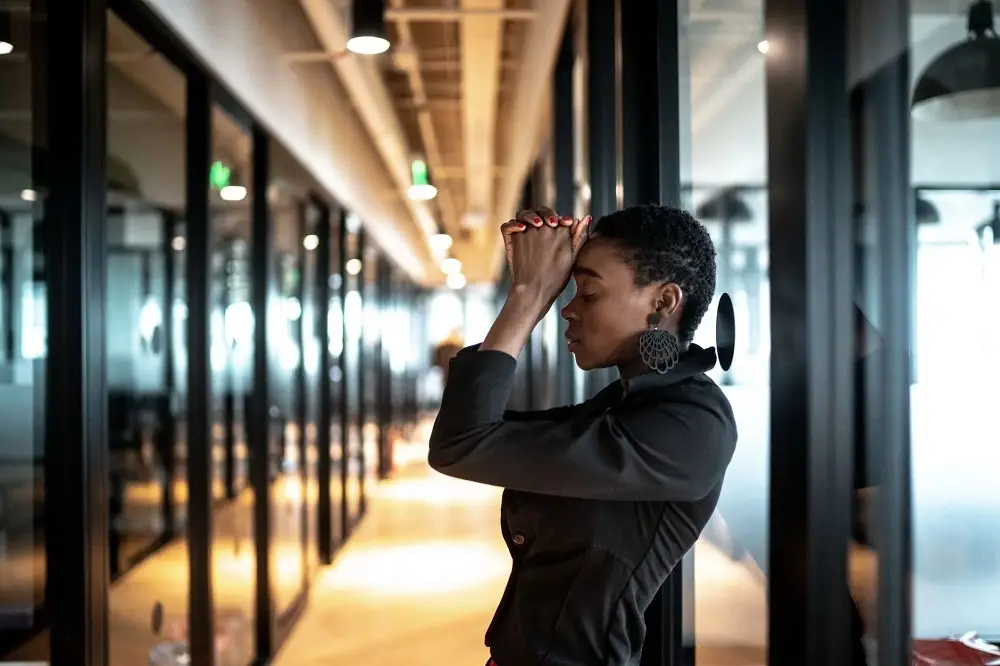
After the interview, I realized that anxiety is not scary. It’s just a nagging but well-intentioned old employee — overly alert, but trying to protect you.
What truly makes people lose control is rarely anxiety itself. It’s your relationship with it. When you treat it as an intruder, it behaves like a thug. When you treat it as a manageable employee, it slowly sits back down in its seat.
Next time anxiety knocks on your door, you don’t need to go to war. You don’t need to run away.
Open the door. Look at it. Say one sentence: “Message received. Please go back to your seat.”