You’re exhausted. Your body is tired. But the moment your head hits the pillow, your brain starts replaying conversations, worrying about tomorrow, and imagining worst-case scenarios.
If this happens every night, you’re not alone. These are just strategies I’ve figured out after way too many restless nights — try whatever seems useful to you.
Why Do We Overthink More at Night?
There Are Fewer Distractions
During the day, your attention gets pulled in a dozen directions. At night, the noise stops. And without those distractions, your thoughts can feel louder than they actually are.
Your Brain Starts Processing Unfinished Stress
Think of your mind as sorting through the day’s leftover thoughts and emotions. Small frustrations, awkward moments, or tasks you didn’t finish — your brain tries to make sense of them when you finally slow down.
Anxiety Often Feels Stronger at Night
There’s something about the dark and the quiet that can make worries feel heavier. What felt manageable at 2 p.m. might feel overwhelming at 2 a.m.
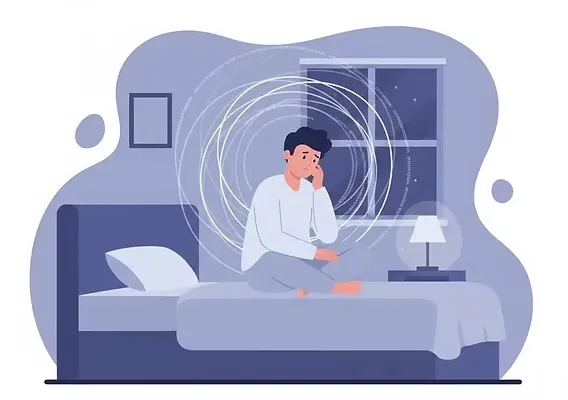
How Overthinking Affects Your Sleep
Racing thoughts don’t just keep you awake longer. They can also make your sleep lighter and more restless. Some people fall asleep fine but wake up in the middle of the night with their mind already spinning. Others lie there for an hour or more before their mind finally quiets down. Either way, you might wake up feeling like you barely rested.
7 Practical Ways to Stop Overthinking at Night
Write Down Tomorrow’s Worries
Keep a notebook by your bed. When a thought pops up, write it down quickly — not in detail, just enough to capture it. This tells your brain: “I’ve saved this. You can let it go for now.”
Last Tuesday I kept replaying whether I’d forgotten to reply to an email. I grabbed a pen and wrote “email to Sarah — Friday deadline.” The thought didn’t vanish completely, but it went from screaming to mumbling. That was enough to fall asleep.
Try the 4-7-8 Breathing Technique
Breathe in quietly through your nose for 4 seconds. Hold for 7 seconds. Exhale completely through your mouth for 8 seconds. This isn’t about clearing your mind. It’s about giving your body something physical to focus on.
Stop Solving Problems in Bed
Your bed is for sleeping, not for strategizing. If you notice yourself trying to solve a work issue or a relationship problem, remind yourself: bedtime is not problem-solving time. You can pick it back up in the morning.
Use a Brain Dump Before Sleep
A few minutes before you turn off the light, grab that notebook again. Write down everything floating around in your head — to-dos, worries, random thoughts. Don’t organize it. Just dump it out.
I used to think I didn’t need to write things down because I’d remember them. Then I’d lie there mentally rehearsing the same grocery list or work task. Now I dump it all out — even stupid stuff like “change air filter” — and my brain quiets down enough to let me drift off.
Replace “What If” Thoughts With Facts
“What if I mess up tomorrow?” Stop and ask yourself: What do I actually know right now? Usually, the facts are a lot less scary than the what-ifs. You might still feel nervous, but you’re not adding made-up scenarios on top.
Listen to a Sleep Story or White Noise
A boring, gentle voice describing a train ride or a quiet walk can pull your attention away from your own thoughts. White noise or rain sounds work the same way — they give your brain something neutral to rest on.
Create a Consistent Bedtime Routine
Going to bed at roughly the same time each night — and doing the same few things before sleep, like brushing your teeth, reading a page or two, or turning down the lights — signals your brain that it’s time to shift gears. This is one of those small habits that can quietly make a difference over time.
For a while I went to bed at a different time every night — sometimes 11, sometimes 2. My brain never knew what to expect. Once I started dimming the lights at 10, making tea, and getting into bed around the same time, I noticed I’d start feeling sleepy before I even turned off the lamp. It wasn’t instant. Took maybe two weeks. But it worked.

What Not to Do When You’re Overthinking at Night
Don’t Check Your Phone
The light alone can keep your brain awake. And whatever you find on social media or in your emails — good or bad — will give your mind something new to dwell on.
Don’t Force Yourself to Sleep
Trying to fall asleep is like trying not to think of a polar bear. The more you try, the harder it gets. If you’ve been lying there for 20 minutes or more, get up. Sit somewhere dark and boring. Read something dull. Go back to bed only when you feel sleepy again.
Don’t Fight Every Thought
If a thought shows up, you don’t have to wrestle it. You can just notice it — “Oh, there’s that worry again” — and let it drift past. Fighting every thought usually makes them stick around longer.
When Nighttime Overthinking May Be a Sign of Anxiety
For some people, overthinking at night is an occasional problem. For others, it’s a nightly battle. If this has been going on for weeks and it’s seriously affecting how you sleep — and how you feel during the day — it might be helpful to talk with someone.
Persistent nighttime rumination can sometimes be linked to an anxiety disorder — but every person’s situation is different. The key isn’t the occasional restless night. It’s when it becomes a pattern that doesn’t seem to lift on its own.
FAQ
Why does my brain think more at night?
Because there’s less going on around you. Your brain fills the quiet space with whatever you didn’t process during the day.
Is overthinking at night normal?
Very common. Most people experience it now and then. It’s not necessarily a problem unless it keeps happening night after night.
Can anxiety keep you awake all night?
Yes. For some people, especially during stressful periods, anxiety can lead to full nights without sleep. But that doesn’t mean you’re broken — it means your nervous system is on high alert.
How do I stop racing thoughts immediately?
There’s no instant cure, but the 4-7-8 breathing technique or getting out of bed for five minutes can help interrupt the loop. You can often turn the volume down fairly quickly, even if the thoughts don’t disappear completely.
Sources:
American Psychological Association – resources on rumination and sleep
National Institute of Mental Health – information on anxiety disorders
Sleep Research Society – published perspectives on bedtime worry and sleep onset