I bought the book on a Tuesday. My sister had called me for the third time that week, asking me to watch her kids. I said yes again. Then I hung up and stared at my kitchen wall, feeling that familiar knot in my stomach.
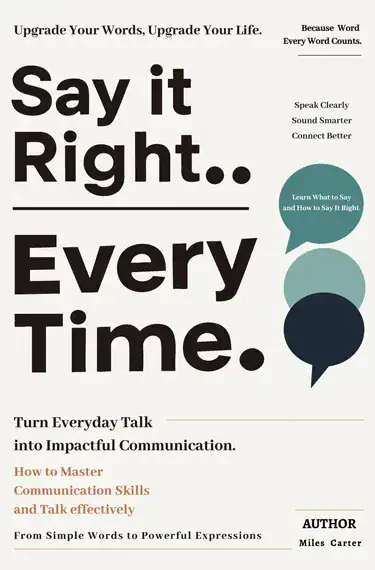
That was when I searched for how to set boundaries book recommendations. I found Say It Right Every Time by Miles Carter. The subtitle caught me: practical tools for the moments that matter. Say what you mean, calmly.
I thought, okay. Let’s see if this actually works.
Why Do I Struggle So Much With Setting Boundaries?
The book opens with a question that stopped me cold. Do you say yes because you want to, or because you are afraid of what happens if you say no?
I had never separated those two things. I thought my yeses were genuine. Then I paid attention for one week. Most of them were fear. Fear of disappointing. Fear of seeming rude. Fear that someone would be angry with me.
Carter calls this the reflex yes. You do not decide. You react. The book says this pattern starts early, usually because we learned that keeping people happy keeps us safe. That made sense to me. I was the child who kept the peace. I never caused trouble. And I carried that into adulthood.
Here is what I appreciated about this how to set boundaries book. It does not shame you for being a people pleaser. It treats it as a skill you learned, which means you can learn a different one.
What Is the Core Method in This Book?
The method is simple to understand but hard to do at first. You pause before you answer. That is the whole foundation. You do not say yes automatically. You do not say no aggressively. You pause.
Then you use what Carter calls the three-part response. First, you acknowledge the request. Second, you state your position. Third, you offer an alternative if you can.
Here is an example from the book that I now use with my sister. She asks me to watch the kids on Friday. I used to say yes immediately. Now I say, I hear you need help on Friday. I cannot do it this time. Maybe we could find a sitter together.
The first time I said this, my voice shook. My sister was quiet for a moment. Then she said, okay, no problem. That was it. No explosion. No guilt trip. I had built the whole thing up in my head for nothing.
Carter includes dozens of these scripts. He compares basic expressions with mature ones. The format is actually helpful because you see the difference side by side. You can see how the same message sounds when delivered with confidence versus with apology.
How Does This Book Handle Workplace Boundaries?
The second half of the book covers work situations. This surprised me because I expected a how to set boundaries book to focus only on personal relationships. But Carter spends a good amount of time on office dynamics.
He breaks it into categories. Saying no to extra projects. Asking for what you need. Handling difficult conversations. Each chapter has case studies that show exactly what to say.
One example stuck with me. A coworker keeps interrupting you in meetings. Carter suggests saying, I was not finished with my point. Can I finish, and then I will hear yours? That is direct. It is not rude. It is clear.
I tried a version of this with a colleague who always talked over me. I said, I would like to finish this thought first. She blinked and said, sorry, go ahead. I could not believe how easy it was.
The book also covers requests. Asking for a raise. Asking for a deadline extension. Asking for help. The pattern is the same. State the situation. State what you need. Stop talking. Do not fill the silence with justifications.
What Are the Most Useful Scripts in the Book?
I marked about ten pages with sticky notes. Here are the ones I actually use.
For a favor I cannot do: I appreciate you thinking of me. I am not able to help this time.
For someone who oversteps: I am not comfortable with that. Let me think about it and get back to you.
For a pushy salesperson: I am not interested. Please do not call again.
For a family member who guilts you: I understand you are disappointed. My answer is still no.
What I love about these scripts is the lack of apology. There is no sorry in any of them. That was a revelation for me. I always prefaced my nos with apologies. The book points out that over-apologizing weakens your message. You do not need to apologize for having a limit.
What Makes This Book Different From Other Boundary Books?
Most books on this topic focus on psychology. They explain why you are a people pleaser. They talk about childhood wounds and attachment patterns. That is useful, but it does not help you on Tuesday afternoon when your sister calls.
This book is different. It is practical. Every chapter ends with scripts you can use the same day. There is no theory to absorb first. You can open to the chapter on saying no and find a script five minutes later.
Carter also includes a lot of comparisons between weak and strong phrasing. You see the same situation handled two ways. The weak version is what most of us say. The strong version is what we wish we said. Seeing them side by side makes the difference obvious.
The book is not long. I finished it in two evenings. That is another thing I appreciated. It respects your time. It does not pad the content with fluff.
How Do I Actually Use This Book in Daily Life?
I keep it on my nightstand now. That sounds dramatic, but it is true. The book has become a reference tool for me.
Here is how I use it. When a situation comes up that I know will be hard, I flip to the relevant chapter. I read the scripts. I choose one that fits. I practice saying it out loud. Then I make the call or send the text.
Last week, my neighbor asked me to collect her mail for three weeks while she travels. I said, I can do one week, but not three. She said, that works. We settled on one week. I felt good about it.
A month ago, I would have said yes to three weeks and then resented every day of it. That is the real gift of this book. It does not just help you say no. It helps you say yes to what you actually want.

What Are the Limitations of This Book?
I will be honest. The book is not deep. If you want to understand why you became a people pleaser, this is not the book for you. It does not explore root causes. It assumes you already know you have a problem and just need tools.
The book also feels repetitive at times. The three-part structure appears in every chapter. That is useful for learning, but it can feel like the author is reusing the same formula.
And some of the scripts feel a little stiff. I would not say them word for word. But they give you a template, and that is enough. You adapt them to your own voice.
For me, those limitations were acceptable. I did not need a deep psychological exploration. I needed someone to show me what to say. This book did that.
What Age Group Is This Book For?
I would say this book is for adults of any age. College students who struggle to say no to friends. Young professionals who cannot push back at work. Parents who need to set limits with extended family. Older adults who have spent a lifetime accommodating others.
The language is simple and direct. There are no academic terms. You do not need a background in psychology to understand it.
Can You Use This Book With Your Partner?
Yes, actually. My husband and I both read it. We now use the scripts with each other. It sounds funny, but it has improved our communication.
Instead of me saying, you always leave your dishes in the sink, I now say, I need you to put your dishes in the dishwasher. It is the same message. It just does not come with blame attached.
Are There Exercises You Can Do While Reading?
Each chapter has a short exercise section. They ask you to write down a situation you are facing and then craft a response using the structure. I did these in a notebook. It helped me prepare for real conversations.
One exercise asked me to list three things I wanted to say no to but had agreed to recently. Then it asked me to rewrite those responses. It was uncomfortable. It was also useful.
One Last Thing
I did not expect a how to set boundaries book to change how I talk to my sister. But it did. Three weeks after reading it, she asked for a favor I could not do. I said no. She said okay. The conversation lasted thirty seconds.
I hung up and sat there. No knot in my stomach. No replaying the conversation in my head. Just a quiet sense of peace. I had said what I meant. I had said it calmly.
That is the whole point of Say It Right Every Time. It does not promise you will never feel awkward. It just gives you the words so you do not have to freeze. And sometimes, that is enough.