How many times have you walked out of a meeting rehearsing what you should have said? You knew the point you wanted to make. You knew the boundary you needed to set. Then the moment came, and the words came out sideways. Too soft. Too sharp. Or not at all.
This article is for the person who knows what they mean but keeps watching it land wrong.
Quick Answer: How do I handle conflict at work without sounding harsh?
Separate the person from the problem. Name what they said, say what you actually think, and offer the next step. Three beats. No blame. No hedge. No speech.
Why Do the Words Change Shape on the Way Out?
I once sat in a quarterly review and watched a colleague raise a real problem with our timeline. She had valid concerns. She had data. What she did not have was a way to say it that did not sound like an attack. The room went cold. Her point got lost. Two weeks later, the same problem surfaced again, worse.
Here is what I have come to believe. Most of us were never taught how to disagree at work. We were taught to be nice. We were taught to be professional. Nobody sat us down and said, here is how you push back without burning a bridge.
So we default to one of two modes. We either swallow it and feel resentful, or we blurt it out and feel guilty. Neither one works. The message gets buried under the tone.
You know what you mean. The trick is getting the other person to hear it.
Why Is Saying No So Hard at Work?
Because work is a place where we trade on relationships. Every no feels like a withdrawal from the account.
I remember a manager who asked me to take on a project that would have eaten my evenings for a month. I said yes. Of course I said yes. Then I spent the next four weeks annoyed at him, annoyed at myself, and too tired to do any of it well.
What I wish I had said was this. I want to help with this. I can take the research piece, but I cannot own the whole thing by Friday. Can we talk about what matters most?
Same willingness. Different outcome. A no that keeps the door open.
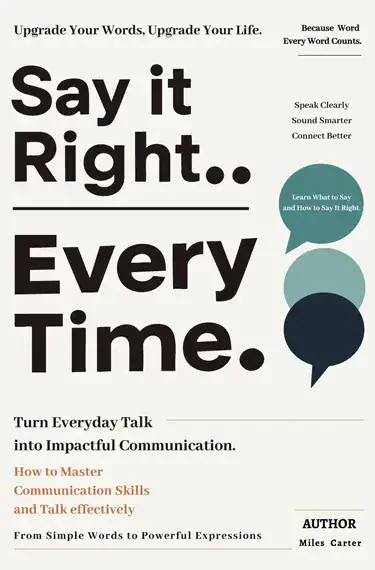
Say It Right Every Time by Miles Carter makes a point that stuck with me. The goal is not to sound perfect. The goal is to say what you mean without sounding too harsh, too passive, or unsure of yourself. That is the whole game.
What Is the Other Person Actually Hearing?
This is the part we skip. We rehearse our words. We do not rehearse their ears.
| You Say | They May Hear |
|---|---|
| I think we should reconsider this approach | You made a bad call |
| I am not sure that timeline works | I do not trust you to plan |
| Can we talk about this later? | I am avoiding you |
| That is an interesting idea | That will never work |
The words are fine. The meaning got scrambled on the way in.
So before the conversation, ask yourself one question. What is the most generous version of what I am about to say? Then say that version.
The Three-Beat Pause
Here is a pattern I have borrowed and adapted over the years. I call it the Three-Beat Pause. Three short beats before you respond to anything hard.
Beat one. Name what they said, in your own words. So the concern is that the deadline moves everything else back.
Beat two. Say what you actually think, plainly. I do not think we can hit it without cutting the testing phase.
Beat three. Offer the next step. Can we look at what we could move instead?
That is it. No blame. No hedge. No speech. Just three beats that keep the conversation moving.
I have used this in performance reviews, in arguments with peers, and once, memorably, in a hallway conversation that could have gone very badly. It worked because it slowed me down long enough to mean what I said.
How Do You Disagree Without Damaging the Relationship?
The answer is simpler than most of us want it to be. You separate the person from the problem.
- You do not say you always miss deadlines. You say this deadline slipped, and I want to understand what happened.
- You do not say that idea will not work. You say help me see how that would work with the current budget.
One is a verdict. The other is a question. Same skepticism. Different door.
People can handle disagreement. What they cannot handle is feeling dismissed. When you make it clear that you are on the same side of the table, the hard message lands as information instead of insult.
Where Did We Learn to Avoid Conflict?
For me, it came from watching adults who did not fight well. Conflict meant silence, then an explosion. So I learned to keep the peace by keeping quiet.
Many of us carry that pattern into the office. We treat every disagreement as a threat to the relationship, when often it is the thing that makes the relationship real.
A coworker once told me something I have never forgotten. I trust the people who push back on me. It means they are actually paying attention.
That reframed everything. Conflict is not the opposite of respect. Handled well, it is a form of it.

One Thing You Can Try Tonight
Before your next hard conversation, write down one sentence. Not a script. Just one sentence that captures what you actually need the other person to understand.
Then say that sentence first. Not last. Not buried under three paragraphs of preamble.
You will be surprised how much changes when the point comes first.
FAQ
How do I give feedback without sounding harsh?
Separate the person from the problem. Talk about the situation, not their character. This deadline slipped lands better than you always miss deadlines.
What if the other person gets defensive?
Do not match their energy. Ask one real question and wait. Help me understand what happened on your end. The silence does more work than your next sentence.
How do I say no without damaging the relationship?
Offer a partial yes. I can take the research piece, but I cannot own the whole thing. That keeps the door open while protecting your time.
What if I freeze in the moment?
That is normal. The thinking brain goes quiet under stress. Write down one sentence before the conversation and say that first. Preparation beats improvisation.
Can conflict actually be good for a team?
Yes. Handled well, it is a form of respect. It means people are paying attention. The goal is not to avoid conflict. It is to disagree without making it personal.
A Closing Thought
You already know what you mean. You have known all along. The work is not in finding better words. It is in trusting that the true ones, said plainly, are enough.
References
- Carter, Miles. Say It Right Every Time.
- Stone, Douglas, Bruce Patton, and Sheila Heen. Difficult Conversations. Penguin Books.
- Patterson, Kerry, et al. Crucial Conversations. McGraw-Hill.