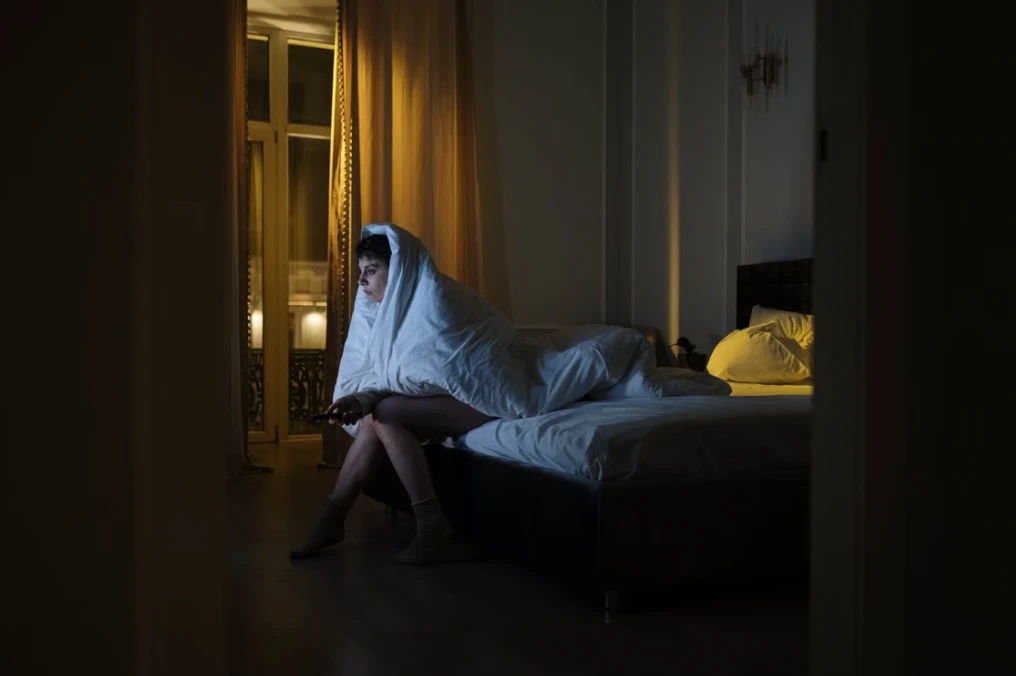
I used to think there was something broken in me. All day I could hold it together. Deadlines, calls, the small fires of adult life, I managed. I’d crawl into bed exhausted, ready to sink into sleep. And then, like a switch flipped, my brain would ignite.
I’d replay a conversation from three years ago. I’d worry about a meeting that hadn’t even been scheduled. I’d ask myself questions no one could answer at 2 a.m.
Why does my anxiety worsen at night?
I didn’t know then. I just felt alone, my heart tapping a restless rhythm against the mattress while the world outside my window slept.
As I talked to more people, I realized I wasn’t broken. I was just human. A lot of people notice that same nighttime spiral. Family members, coworkers, even strangers in late-night forums describe the same wave of dread once the sun goes down.
It happens often enough that many people recognize the pattern: the world gets quiet, but their thoughts get louder.
Quick Answer: Why Does Anxiety Worsen at Night?
Anxiety often feels worse at night because daytime distractions disappear, your brain has fewer external anchors, and tiredness can make emotions harder to regulate. The goal is not to force anxious thoughts away. It is to create a calmer response through small habits like writing worries down, grounding yourself, and creating a healthier bedtime routine.
Why Does Anxiety Worsen at Night Exactly?
The honest answer, I’ve learned, is a mix of biology and circumstance. During the day, my brain is a stage manager juggling a dozen tasks. The pings, the notifications, the errands, the small talk—all of it demands attention.
That noisy backdrop keeps a lid on the anxious thoughts trying to sneak through. At night, the lid comes off.
Our bodies have an internal clock that helps regulate sleep and alertness. As evening progresses, the body naturally shifts toward rest. When you are still awake while feeling tired, emotional regulation can become more difficult, especially when there are fewer distractions around.
Some research suggests that mood and emotional control can become more vulnerable late at night. The same mind that brushed off a tense email at lunch can suddenly treat it like a catastrophe at midnight.
It isn’t a personal failure. For many people, nighttime simply creates the conditions where worries feel louder and harder to manage.
Add isolation to the mix, and the spiral tightens. During the day, if I feel anxious, I can text a friend or distract myself with a walk. At night, everyone’s asleep.
I’m the only person awake, swimming in my own head. There’s no outside voice to pull me back. My brain, with nothing else to do, starts cataloging every possible worst-case scenario.
It feels so real. Even when I know logically nothing has changed, the fear sits heavy in my chest.
I’ve also learned that poor sleep and anxiety can feed each other in a loop. A short night of sleep can make me more vulnerable to worry the next day. Then that worry can make it harder to sleep the following night.
It’s a cycle that can build quietly without you noticing.
How to Stop the Nighttime Spiral When Anxiety Gets Worse
For a long time, I tried to fight the spiral with willpower. I’d lie there and tell myself, “Just stop thinking.”
That never worked.
What helped was learning to work with my brain instead of against it. The strategies I use now aren’t complicated, but they’re consistent. They help me step off the anxiety loop before it tightens.
Practical Ways to Calm Anxiety When It Gets Worse at Night
- Give your worries a scheduled time. Instead of fighting every anxious thought at bedtime, create a short worry session earlier in the evening.
- Create a clear separation between thinking and sleeping. Avoid turning your bed into a place where you solve every problem.
- Use a simple grounding routine. Bring your attention back to your body through breathing, physical sensations, or writing.
The first thing I did was give my worry a designated time. I set aside exactly 10 minutes every day, usually right after dinner, and I call it my worry appointment.
I sit down with a timer and let every anxious thought flood in. I write them all down. The big fears, the petty ones, the what-ifs.
When the timer dings, I close the notebook.
If worries pop up later, I say to myself, “I see you. I’ll get to you at tomorrow’s appointment.”
It sounds silly. But my brain starts to trust that I’m not ignoring the fear. I’m just scheduling it.
The 10-Minute Worry Session That Saved My Sleep
This practice works because it separates worrying from problem solving.
Most of us, when we lie awake at 1 a.m., think we’re being productive. Surely if we replay that awkward conversation enough times, we’ll find the perfect response.
We won’t.
Nighttime worry is often less about solving problems and more about getting stuck in a mental loop.
The daytime worry session teaches my brain a new pattern. Now when anxiety creeps in after dark, I can say:
“Not now. You had your turn.”
It took a couple of weeks, but the late-night chatter became easier to manage.
When Bed Becomes a Battleground
Another shift was changing how I approach my bed.
I used to go to bed early to “catch up” on sleep. I’d lie there for an hour, staring at the ceiling, getting more and more frustrated.
Now I don’t get into bed until I’m genuinely sleepy. I might read on the couch or tidy the kitchen. I wait for that heavy-limb feeling.
If I get into bed and 15 minutes pass and I’m still wide awake, I get up. I walk to the living room and do something boring.
I might read the manual for my coffee maker or organize a drawer.
The point is to break the association between my bed and wakeful worrying. My brain needed to learn: bed equals sleep, not battle station.
This was the hardest habit to build, because getting up at 2 a.m. feels wrong. It feels like giving up.
But staying in bed while my mind races only teaches my body that bed is a place for panic.
Over time, that training stuck. Now, if I wake in the night with my heart pounding, I know the drill.
I get up, drink a sip of water, maybe sit quietly for a few minutes. Usually, within twenty minutes, the wave passes.
I’m not fighting it. I’m just stepping out of the ring.
The Bedside Reset: A Simple Framework for Soothing Night Anxiety
After months of trial and error, I landed on a small ritual that I now call the Bedside Reset.
It’s the thing I reach for when anxiety flares at 3 a.m. and I’m too tired to remember all the advice I’ve read.
The whole thing takes less than two minutes. It has three steps:
- Catch it: Notice the worry instead of immediately following it.
- Scribble it: Write down the thought in one simple sentence.
- Breathe out: Take a few slow breaths and remind yourself that the thought is real, but it is not urgent right now.
Here’s how it works.
When I notice my thoughts spiraling, I don’t argue with them. I just silently say:
“I see the worry.”
That’s the catch.
Then I reach for the tiny notebook on my nightstand. I write one sentence.
Not a journal entry. Just one line.
Something like:
“Work presentation on Thursday.”
Or:
“Did I say that wrong?”
I don’t solve it. I don’t elaborate. I close the notebook and put my hand on my chest.
I take three slow breaths. In through my nose, out through my mouth.
I tell myself:
“This is real, but it’s not urgent right now.”
The Tiny Notebook That Talks Back to Your Brain
That notebook isn’t a diary. It’s a parking lot.
I’ve learned that my anxious brain needs to feel heard, not silenced.
Writing a brief note signals to my mind that I’ve registered the concern. I’m not dismissing it. I’m simply postponing the full conversation until morning.
The physical act of closing the notebook helps me close the mental loop.
Over time, that tiny gesture became a signal. My brain knows that once the notebook shuts, it is time to stop processing and allow rest.
I used to marinate in my worries, turning them over until they grew.
Now I capture them and release.
What to Do When You Wake Up at 3 A.M. and Panic Sets In
If I wake up later, say around 3 a.m., with the full-body hum of anxiety, I use a variation.
I don’t lie there. I get up, take the notebook with me to the couch, and do the same scribble ritual.
Then I sit in the dark and do a slow, counted breathing exercise.
I breathe in for four counts, hold for four, breathe out for six.
I do that until my shoulders drop.
Sometimes it takes three minutes. Sometimes fifteen.
The key is that I’m not reinforcing the cycle of anxiety and wakefulness in bed.
Once the sharp edge has dulled, I go back to bed.
More often than not, I sleep.
Common Questions About Why Anxiety Worsens at Night
Why does my anxiety worsen at night even though I’m exhausted?
Exhaustion and sleepiness are different.
You can be mentally drained but still physically alert, and the drop in daytime distractions can expose worries you pushed aside.
Your brain is tired but not always calm. It’s like an overtired child who cannot settle.
That wired-tired state can make nighttime rumination feel much stronger.
Is it normal for anxiety to worsen at night but not during the day?
Yes. Many people experience this pattern.
Daytime provides structure and engagement. Nighttime removes those external anchors, so internal thoughts can become louder.
It does not mean your anxiety is less real during the day. It simply means your coping resources may be lower after a long day.
Why do I only feel anxious at night?
Many people notice anxiety more strongly at night because quiet moments leave more space for thoughts that were pushed aside during the day.
Stress, tiredness, fewer distractions, and being alone with your thoughts can all make worries feel more intense.
If nighttime anxiety is affecting your sleep or daily life for a long period, talking with a mental health professional can be a helpful step.
Can anxiety worsening at night be a sign of a sleep disorder?
Sometimes, nighttime anxiety can overlap with sleep problems.
If you regularly wake up gasping, have nightmares that repeatedly wake you, or feel exhausted despite enough time in bed, it may be worth discussing with a healthcare professional.
For many people, though, nighttime anxiety is a pattern that can improve through changes in habits, stress management, and emotional regulation skills.
How long does it take to stop anxiety from worsening at night?
It varies from person to person.
When I started the worry appointment and the Bedside Reset, I noticed small differences within a week. After a month, the 3 a.m. wake-ups felt less intense.
It’s not a cure. It’s a practice.
Some nights I still stumble. But I know how to catch myself now.
That knowledge alone eases the edge.
I think back to those early nights when I felt broken, when I was the only person awake in a sleeping world.
I wasn’t broken.
I was just a person whose brain, when given silence, filled it with fear.
Now when the spiral starts, I have a notebook and a few practiced breaths.
It’s not magic.
It’s just a small, steady way to say to myself:
“I’m still here. This will pass.”