If you have ever typed books for overcoming anxiety into a search bar at midnight, you already know the problem. There are ten thousand results. Every cover promises calm. Most of them sit on your shelf after chapter two, half-read, quietly accusing you.
I know because I bought eleven of them in one year. This article is what I wish someone had handed me instead. How to choose, how to read, and what actually shifted things for me.
Quick Answer: Which anxiety books actually help?
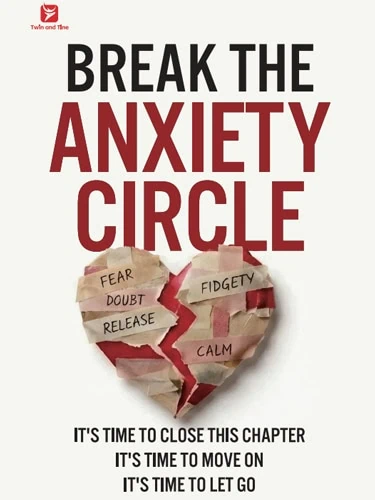
The ones that give you something to try, not just something to nod at. Break the Anxiety Circle by Miles Carter is a good example. It keeps its promises small and gives you one action per chapter.
Why You Buy Books and Never Finish Them
Here is what nobody tells you. Most people do not fail at reading self-help books. They fail at choosing them.
I used to buy whatever was on the front table at the bookstore. Bright cover. Big promise. I would read forty pages, feel briefly hopeful, then lose interest.
The turning point came when a friend lent me Break the Anxiety Circle by Miles Carter. What struck me was not the cover. It was that the book kept its promises small. One chapter on indecision. One on self-blame. Each section ended with something I could actually do that same evening.
That is the first filter for any book you pick up. Does it give you something to try, or just something to nod at? Nodding feels good for an hour. Trying something changes a Tuesday.
What These Books Are Really Solving
If you are searching for books for overcoming anxiety, the real question underneath is usually this. Why can I not stop thinking?
A simple text message becomes an hour of analysis. A small mistake becomes proof you are fundamentally flawed. Your mind keeps searching for answers even when there is nothing left to solve.
The best books I have read on this do not try to stop the thinking. They interrupt the loop. There is a difference.
One evening, I caught myself replaying a work email for the fourth time. I stopped and asked, what am I actually trying to solve here? The answer was nothing. The email was sent. The loop was just running because stopping felt unsafe.
That moment came directly from something I read, not from willpower. Books can hand you that question. You still have to ask it.
The Loop Interrupt
This is the tool that helped me most, and I have adapted it from several books including Carter’s. I call it the Loop Interrupt. It takes about ninety seconds.
Notice the loop. Not judge it. Just notice. I am replaying something.
Ask out loud, or on paper. Is there an action available to me right now? Yes or no.
If yes, write the action down with a time next to it. If no, say one sentence to close it. This is finished. I do not need to solve it again.
Move your body for sixty seconds. Stand up. Walk to the kitchen. Anything physical.
That is it. It sounds too simple. I thought so too. But the fourth step matters more than the rest. A racing mind lives in a still body. Moving breaks the spell.
The first week, I did this maybe fifteen times. By the third week, I noticed the loops getting shorter on their own.
Why Interrupting Beats Understanding
Because thinking got you into this. Thinking will not get you out.
I spent years trying to reason my way to calm. If I could just understand why I felt this way, I would feel better. That approach has a hidden trap. It keeps you in your head, which is the exact neighborhood where the anxiety lives.
Interrupting is different. It does not require you to understand anything. It only requires you to notice and redirect. Understanding often arrives later, quietly, while you are doing something else.
When Reading Becomes Overthinking
Honest answer. When reading becomes another form of overthinking.
I have done this. Reading five books about anxiety instead of doing one thing from one book. It feels productive. It is not. It is the loop wearing a smarter outfit.
My rule now. One book at a time. One practice at a time. If I catch myself buying a new book before finishing the current one, that is a signal, not a solution.

The Three-Page Rule
Most people quit self-help books around page forty. I did, repeatedly. Here is what fixed it for me.
Read three pages. Then close the book and write one sentence. What did I just read that applies to me today? If you cannot write the sentence, you are not reading. You are scrolling with extra steps.
I also stopped reading these books at night. Night is when my mind is tired and dramatic. Morning reading, with coffee, ten minutes. That is it. Ten minutes daily beats three hours on Sunday.
And I stopped highlighting. Highlighting feels like action. It is not. Now I dog-ear a page only if I plan to try something from it this week.
Two Chapters That Hit Harder Than the Anxiety Material
Two chapters in Carter’s book stayed with me longer than the rest.
The first was about people-pleasing. Saying yes when you mean no. The framing stayed with me. Every yes you do not mean is a small debt you owe yourself later. I started noticing how often I agreed to things out of pure reflex.
The second was about the past. Old regrets. Missed chances. The book does not ask you to forgive yourself overnight. It asks a smaller question. Can you stop fighting what already happened? Understanding your past is different from endlessly prosecuting it.
I am not going to pretend one book resolved either of these for me. But it gave me language for things I had felt for years without words. That has its own kind of value.
Three Filters for Choosing a Book
After eleven books, here is my short list.
Does it include exercises? Not reflection questions. Actual things to do. Carter’s book passes this. Many do not.
Does the author sound like a person? Some books read like they were assembled by a committee. You want a voice, even an imperfect one.
Does it cover more than one problem? Anxiety rarely travels alone. Overthinking, indecision, self-blame. They tend to arrive together. A book that addresses the cluster is worth more than one that treats a single symptom.
Is it honest about difficulty? Any book promising to eliminate anxiety in thirty days is selling you a feeling, not a method.
A Closing Thought
Here is the moment I keep coming back to. It was a Tuesday, nothing special. I was washing dishes, and I realized I had not replayed a single conversation all day. No loop. No courtroom in my head.
I did not feel triumphant. I felt quiet. Almost bored, in the best way.
That is what these books gave me, in the end. Not transformation. Not a new personality. Just more quiet Tuesdays than before. If that sounds small, you probably have not had one in a while.
References
- Carter, Miles. Break the Anxiety Circle.
- Brewer, Judson. Unwinding Anxiety. Avery, 2021.
- Harris, Russ. The Happiness Trap. 2nd ed., Shambhala, 2022.